COMPONENT 140%
Devising Theatre
Create and develop original theatre from an Eduqas stimulus using a practitioner or genre. Perform or design, build a portfolio and evaluate.
Open the C1 journey →Your clear route through GCSE Drama — from the first stimulus to the final performance and written exam. Created by Miss B.OK.
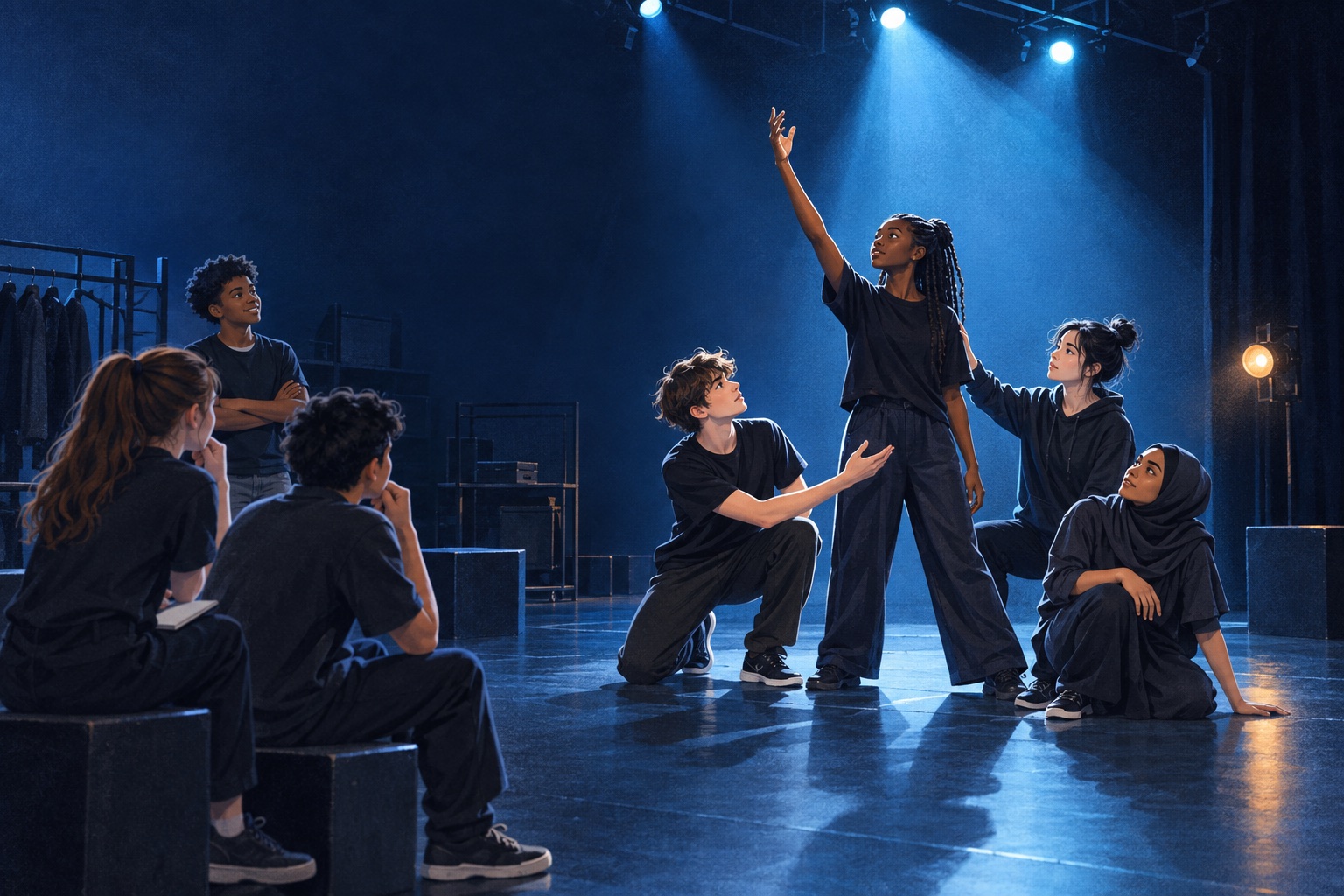
Every section teaches you what to do, why it matters and how to improve it.
Create original theatre from a stimulus. Develop, perform or design, document and evaluate.
Open Mission Control →Interpret two extracts and realise your ideas you want to communicate as a performer or designer.
Open Text to Performance →Master the set text and learn to analyse and evaluate live theatre with precision.
Open the study centres →Know what each component asks you to do, what the assessment objectives mean, and where to go next.
Create and develop original theatre from an Eduqas stimulus using a practitioner or genre. Perform or design, build a portfolio and evaluate.
Open the C1 journey →Study two extracts from one text, then realise your ideas you want to communicate as a performer or designer in a live assessment.
See the C2 destination →In a 90-minute written exam, answer questions about your set play and a live performance you have seen.
See the C3 destination →An AO is an assessment objective: a skill that is marked. Each part of the course checks different skills.
Show how your ideas grow, change and become clearer for an audience.
Assessed in Component 1Use acting or design skills to show your ideas on stage.
Assessed in Components 1 and 2Explain how drama and theatre are developed and performed.
Assessed in Component 3Explain what a choice did. Say how well it worked. Give an exact example to support your view.
Assessed in Components 1 and 3Make your own piece of drama from a starting point. Keep notes that show what you tried and how your ideas changed.
Understand the complete mission before you make your first creative choice.
Devise from the set stimulus using the techniques of a practitioner or the characteristics of a genre.
Choose evidence from three significant development stages. Written guidance: 750–900 words in total.
Apply your chosen theatrical skills live and contribute to the piece as a whole.
Analyse and evaluate your own work after the final performance or design.
Your teacher must see your work in development at least three times. This hub adds visible reminders at the three significant stages.
Slow down the rush to “a story”. Investigate what the stimulus suggests, evokes and questions.
List only what is actually present: words, details, colours, sounds, contrasts or facts.
Generate several possible meanings, emotions, themes and viewpoints.
Ask who, what, where, when, why, what changed and what is hidden.
Turn one discovery into a still image, soundscape or short improvisation.
Collect 20 observations, turn them into 10 possible ideas, then physically test one idea for 60 seconds. Do not write a plot first.
Use research to create sharper theatre choices — not to fill pages with copied information.
After every useful fact, complete this sentence in your own notes:
“This could change our theatre because…”
If it does not influence meaning, character, structure, style, performance or design, it may not need space in your process.
Confirm that your research direction is appropriate, safe and relevant before turning it into detailed material.
Build several genuinely different possibilities, then choose using dramatic potential rather than convenience.
A direct response that keeps the stimulus visible.
Change time, place or viewpoint while protecting the core meaning.
Challenge the most obvious reading or reveal what is usually unseen.
Decide what you want the audience to understand, feel or question — and how acting or design choices will make that happen.
Eduqas requires a route through an influential practitioner or a genre. Your choice must shape the theatre, not become decoration.
Investigate techniques and ideas associated with one influential theatre practitioner, then apply them with purpose.
Open Practitioner Library →Investigate the recognisable characteristics of a dramatic genre or style, then use them consistently to show an idea.
Open Genre & Style Library →Your teacher can advise whether the combination of stimulus and practitioner/genre is suitable. Confirm the route before committing.
Treat rehearsal as a cycle of purposeful experiments, not repeated run-throughs.
Start with the problem you can see or feel. The toolkit will route you to a useful technique.
Choose evidence showing how your response to the stimulus moved from exploration into developing theatre.
Show this stage in development to your teacher. Keep your own dated drafts or process evidence as instructed by your centre.
Show how ideas from your chosen practitioner or genre were incorporated into the piece for a reason.
Ask your teacher to observe how the chosen practitioner or genre is working in rehearsal.
Select a moment where testing, feedback or reflection caused a meaningful amendment.
Show your teacher this stage while you are still working on it. They must be able to check that the work is yours.
Build a selective working record focused on three significant stages — not a diary of every rehearsal.
Research, creation and development in response to the chosen stimulus.
How relevant ideas were incorporated to show an idea.
How ideas were developed, changed and refined during the process.
Eduqas written guidance: 750–900 words in total. Each stage is approximately 250–300 words.
Open the blank log, sentence starters, writing structures, annotated practice examples and layout lab.
Both pathways contribute to the same live piece, but the evidence and practical priorities are different.
Shift from developing material to delivering a consistent, safe and intentional final realisation.
Agree text/action, blocking, design choices, transitions and cues. Remove accidental variation.
Protect listening, focus, timing, ensemble awareness and audience communication.
Strengthen beginnings, endings, transitions, key moments and technical precision.
Check space, costume, props, equipment, safety, identification and recording arrangements with staff.
After the final performance/design, analyse what you did and judge how effectively it worked.
Analyse and evaluate your view of the scene of character/role or realisation of design in the final performance.
Analyse and evaluate how your own performance or design skills contributed to effectiveness.
Judge your individual contribution and how effectively you fulfilled aims linked to the stimulus and practitioner/genre.
Name the exact choice, locate the moment, explain its effect on meaning or audience, then judge how successfully it fulfilled the intention. Write the assessed response yourself.
Use this as a conversation checklist with your teacher. Official school assessment instructions always take priority.
These checks are for practice only and are cleared when the page reloads.
Tell Rehearsal Rescue what is not working. It will suggest practical tools, what to notice and how to capture development.

Every route recommends a small number of focused tools. Try one, notice the effect and keep only what improves the work.
Pressure-test a character’s knowledge, beliefs and backstory.
Open tool → CHARACTERGround choices in the facts of the dramatic world.
Open tool → CHARACTERGive the character an active, playable want.
Open tool → CHARACTERChange what the performer does to get what they want.
Open tool → CHARACTERUse imaginative circumstances to unlock believable choices.
Open tool → CHARACTERMap outer facts and inner thoughts before improvising.
Open tool → MEANINGReveal what a character means beneath the words.
Open tool → MEANINGMake internal thoughts temporarily audible.
Open tool → DEVISINGExplore unseen moments outside the scripted or devised scene.
Open tool → RELATIONSHIPSMake shifts in power visible and playable.
Open tool → PHYSICALITYUse distance and position to communicate relationships.
Open tool → PERFORMANCESelect and control the voice to serve meaning.
Open tool → PERFORMANCEMake physical choices precise, readable and sustained.
Open tool → REFINEMENTCompare contrasting solutions before committing.
Open tool → REFINEMENTCheck what a fresh viewer actually understands.
Open tool → REFINEMENTObserve the work from the audience perspective.
Open tool → POLISHRehearse technical moments and transitions efficiently.
Open tool → POLISHTest the complete performance under final conditions.
Open tool → STRUCTURESee and reshape how dramatic pressure changes over time.
Open tool → ENSEMBLEStrengthen shared focus, rhythm and response.
Open tool → TRANSITIONSMake scene changes intentional and theatrically alive.
Open tool → STYLECheck whether practitioner or genre choices serve meaning.
Open tool → POLISHTarget the small details that shape final impact.
Open tool →No tools match that search. Try a problem such as “character”, “voice” or “refinement”.
KS3: skills first. Year 10: try the core workshops before choosing an approach.
Open the core workshop sequence →
Write down what you tried and what changed. Later, choose the important moments to help plan your own portfolio.
Your entries stay in this open tab only. Download the notebook file to your school storage, then open it here next time. There is no automatic saving or upload. Use character or role labels; leave out real names and personal information.
A two-minute reflection: what you tried, what changed and what comes next. You can expand it later.
Shortlist the moments that show development. A rehearsal collection is preparation for your own writing, not the assessed portfolio.
Export groups your shortlisted entries by stage and keeps your words exactly as entered. It does not write a portfolio response.
The text/PDF is for reading and planning. Use Download notebook for the editable file you can reopen.
Writing structures and examples →Follow the same scene, character choice or design idea across rehearsals. Read your starting point, experiments and results together.
Entries appear in the order you added them, with your own lesson labels. “Before → change → after” is a rehearsal thinking tool, not the three assessed portfolio stages.
Place each entry where it best supports your development. Shortlist the significant moments and use the questions to decide what still needs explaining.
This is your selection board. “Note recorded” only means that a field contains text; it is not a quality judgement, mark or teacher authentication.
Research may support Stage 1, practitioner or genre application Stage 2, and amendment or refinement Stage 3. Choose the main connection for each entry; the board does not limit you to one entry per stage.
Use writing structures and practice examples →Use your real rehearsal notes to practise clear writing. Your assessed portfolio must use your own words and decisions.
Add your own entries, shortlist evidence and download a notebook you can reopen next lesson.
A rehearsal log is a short record of what you did. It is not your finished portfolio. Later, choose the changes that matter most.
Replace every bracket with your own precise evidence. Delete the starter when your meaning is clear.
These are flexible thinking sequences. They are not paragraph formulas you must follow word for word.
These models use the fictional workshop project The Last Light. It is not an Eduqas stimulus or student submission.
At the start of the practice project, our image of a deserted platform led us to focus on isolation. My first improvisation placed every character still and facing outwards, but the scene only showed sadness and had no change. Research into bystander behaviour gave us a more active question: why do people notice a problem but wait for someone else to act? We built a repeated sequence in which three performers saw an abandoned bag but copied each other’s hesitation. During the run, the shared pause became the turning point. This developed our idea from a general mood into a scene about collective responsibility, giving the audience a clearer question rather than a simple story.
Our intention was to make the audience question why people follow a group. In the first version, the performers stayed fully inside the action. To create a more critical relationship, we tested an Epic Theatre convention: each performer stepped out to state the excuse their character was making, then re-entered the repeated sequence. An audience test showed that the excuses made the social choice clearer, but interrupting every repetition slowed the scene. We kept one direct-address moment before the final repetition and removed the others. This made the convention part of the meaning rather than decoration and invited the audience to compare the characters’ excuses with their actions.
Video review showed that our transition into the final scene lasted eighteen seconds and the ensemble dropped focus while moving the blocks. The next version used a cue-to-cue rehearsal. We assigned each block to one performer and repeated the earlier hesitation rhythm while the space changed. This reduced the transition to nine seconds, but speed made the final image untidy. We amended the last four counts so the central performer arrived first and the others formed the image around them. A second review showed a cleaner focal point and no break in the established rhythm. The transition now developed the theme instead of pausing the performance.
“We used thought tracking and it worked well because it was effective.”
“The first thought track repeated information the audience already knew. We replaced it with the character’s unspoken fear, then shortened the freeze so the next action felt more urgent.”
Choose a format approved by your teacher. Clear hierarchy matters more than decorative design.
A picture, sketch or note helps show your point. You must still explain what changed and why.
Practice state only. These checks are not saved.